25th of July: The birthday that changed reproductive medicine
On 25 July 1978, Louise Brown became the world's first baby born after IVF — and the story behind that date is less straightforward than it sounds.
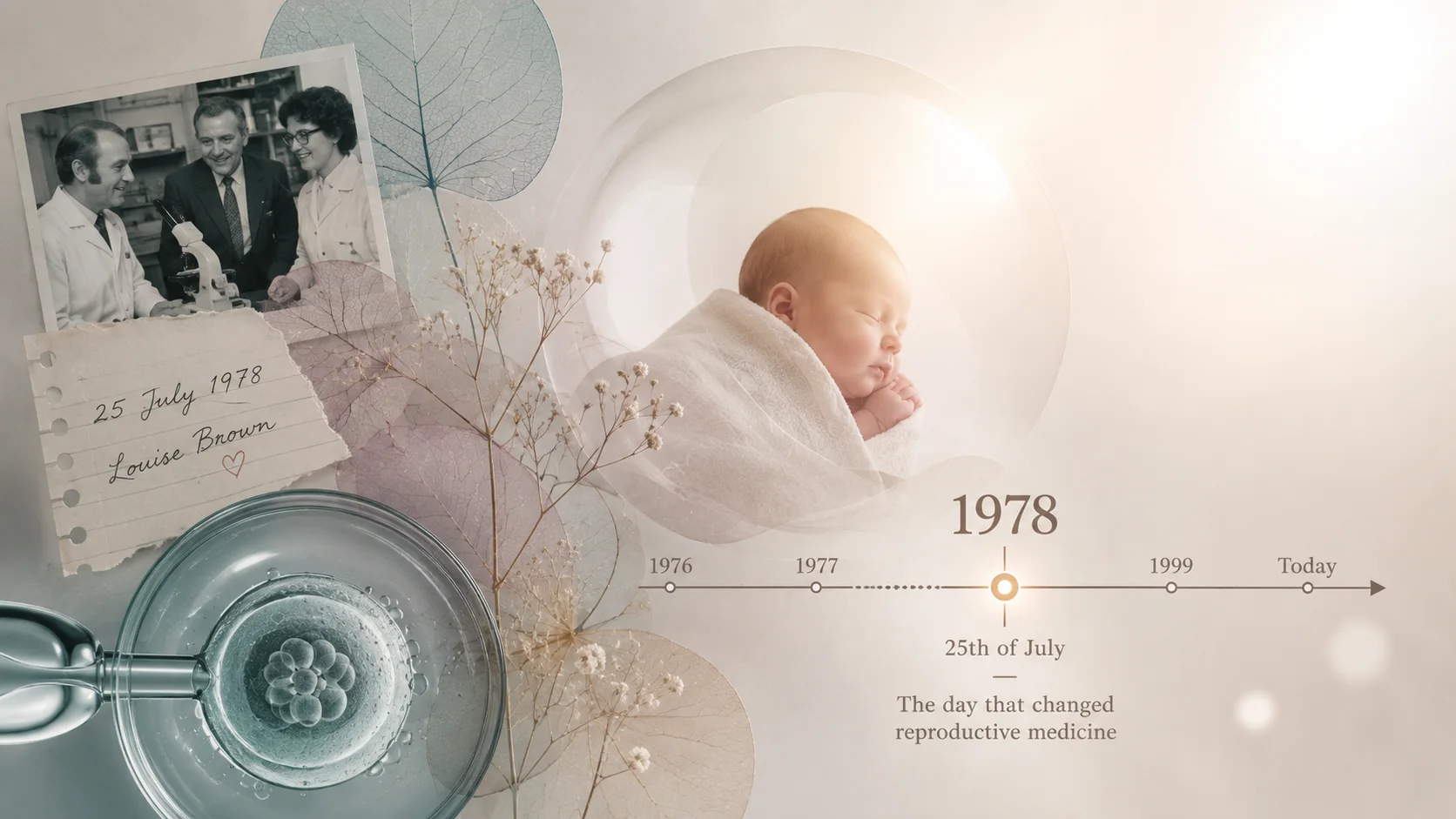
Every year, 25 July is celebrated as World Embryologist Day, and is also often referred to as World IVF Day.
What many people don't know is that Louise's story began with a very specific medical problem. Her mother, Lesley Brown, had both fallopian tubes blocked. This meant that sperm and egg simply could not meet. In other words, pregnancy could not happen naturally. IVF was developed precisely to bypass this obstacle.
The road to success started many years before and was anything but straightforward. Two years earlier, in 1976, the pioneering team of Patrick Steptoe, Robert Edwards and embryologist Jean Purdy achieved the first pregnancy following IVF — but it turned out to be an ectopic (tubal) pregnancy and could not continue. That setback became an important lesson rather than the end of the story. A year later, in November 1977, they achieved the first successful ongoing IVF pregnancy — Lesley Brown's. On 25 July 1978, that pregnancy resulted in the birth of Louise Brown, changing reproductive medicine forever.
One more reassuring chapter followed years later. Louise's younger sister, Natalie, also conceived through IVF, became the first IVF-conceived woman to have a naturally conceived child in 1999. Louise herself later had two naturally conceived sons. Together, the Brown sisters helped answer one of the biggest questions people had in the early days of IVF: could children conceived through IVF grow up healthy and have families of their own? The answer, now supported by decades of evidence and millions of births worldwide, is yes!
Today, the story of IVF is no longer defined by a single remarkable birth. We are now seeing second- and even third-generation IVF families. Millions of people conceived through IVF have reached adulthood and started families of their own, and extensive research has found no clinically meaningful reduction in their fertility compared with the general population.
So far, millions of children have been born through IVF. Behind every one of them is an embryologist, quietly working behind the microscope, helping to create the very first chapter of a new life.
Happy World Embryologist Day!
Assisted Reproductive Technology after the Birth of Louise Brown
Mahran A. et al. Journal of Reproduction & Infertility. 2013;14(3):96–109. Free full text.
History of ASRM — American Society for Reproductive Medicine
If you enjoy the history behind medical breakthroughs, this ASRM timeline is a wonderful read. It tells the story of infertility treatment long before IVF — and the many discoveries that made modern reproductive medicine possible.